Concrete Block Core-Filling vs. Carbon Fibre: Which Reinforces Bowing Walls Best?
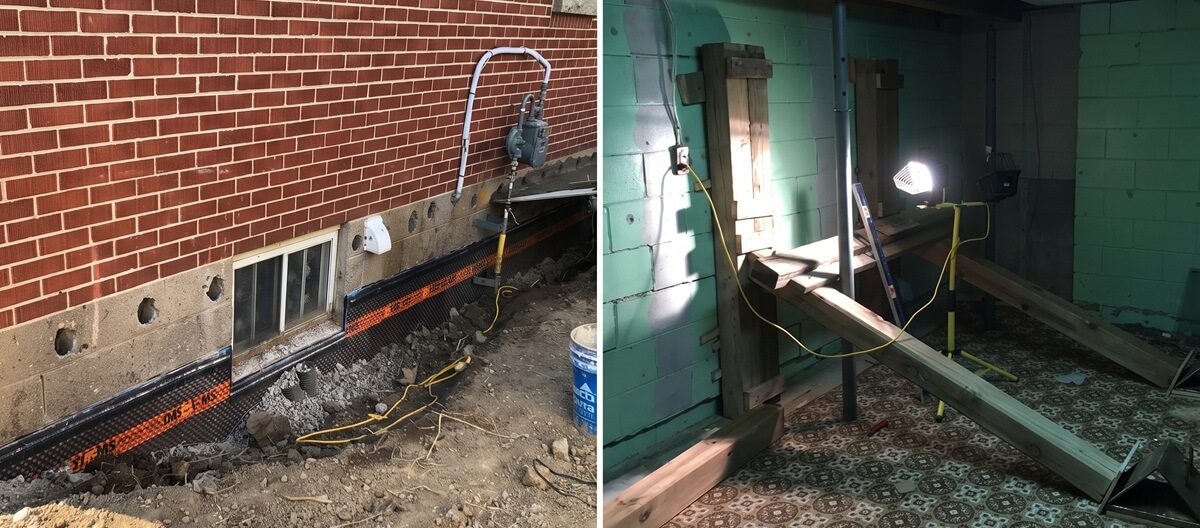
For residential property owners and structural engineers, few issues are as alarming as discovering severe subgrade wall deflection. When a home’s foundation begins inward displacement, it signifies a direct failure of the building envelope’s structural resistance against environmental load forces. In residential construction, the structural perimeter often consists of standard hollow concrete block units. While these blocks offer high compressive strength under downward vertical loads, their horizontal tensile strength is notoriously modest.
Over time, the cumulative impact of water saturation and soil expansion creates pressure exceeding the shear threshold of the masonry joints. This manifests as structural distress, most characteristically evidenced by distinct horizontal cracking along mortar lines and inward bowing basement walls. Once a foundation wall has deflected inward, ignoring the issue guarantees progressive structural deterioration, door and window binding, upper-story drywall shear, and ultimately, total wall collapse.
When seeking structural stabilization, engineers and contractors primarily weigh two distinct remediation methods: traditional concrete block core-filling paired with vertical rebar reinforcement, and advanced high-tensile carbon fibre composite strapping. Both methods aim to arrest inward wall movement and prevent a shifting foundation from compromising the dwelling, but they function on drastically different structural mechanics, load paths, and installation requirements.
The Threat of Lateral Hydrostatic Pressure on Block Foundations
To understand why foundation walls fail, one must examine the subterranean forces acting continuously against below-grade structural masonry. The primary engine behind basement wall deflection is unmanaged lateral soil pressure and cumulative hydrostatic pressure. Hydrostatic pressure develops when subsurface water accumulates in the backfill soil surrounding a building’s perimeter foundation. As rain, melting snow, or high groundwater tables saturate the backfill zone, water fills the void spaces between soil particles.
Dry soil typically exerts lateral earth pressure ranging between 30 to 40 pounds per cubic foot (pcf) equivalent fluid pressure. However, fully saturated soil combined with lateral hydrostatic pressure can exceed 62.4 pcf of fluid pressure plus soil weight, pushing effective lateral forces to well over 75 to 100 pcf. On an 8-foot basement wall, this creates thousands of pounds of continuous pushing force per linear foot.
Because an unreinforced hollow concrete block wall consists of individual masonry units bound together by mortar, its ability to withstand lateral bending forces is strictly dictated by the flexural tensile strength of the mortar-to-block bond interface. Mortar possesses remarkable compressive strength, but virtually negligible tensile strength. As lateral hydrostatic pressure pushes against the center section of the wall—where the lateral deflection moment is highest—the interior face of the wall undergoes severe tension. When bending forces exceed the flexural tensile limit, the joint splits open, creating classic horizontal cracking. Once horizontal cracking initiates, the wall degrades into two hinged plates pushing inward, accelerating the phenomenon of bowing basement walls and creating a severe shifting foundation condition.
What is Foundation Core-Fill Reinforcement?
Foundation core-fill reinforcement is a structural remediation strategy designed to transform lightweight hollow block masonry into a reinforced concrete wall system. By filling the internal vertical voids of the hollow blocks with high-slump concrete or fluid structural grout embedded with steel deformed bars, core-filling restores mass, shear strength, and flexural bending capacity.
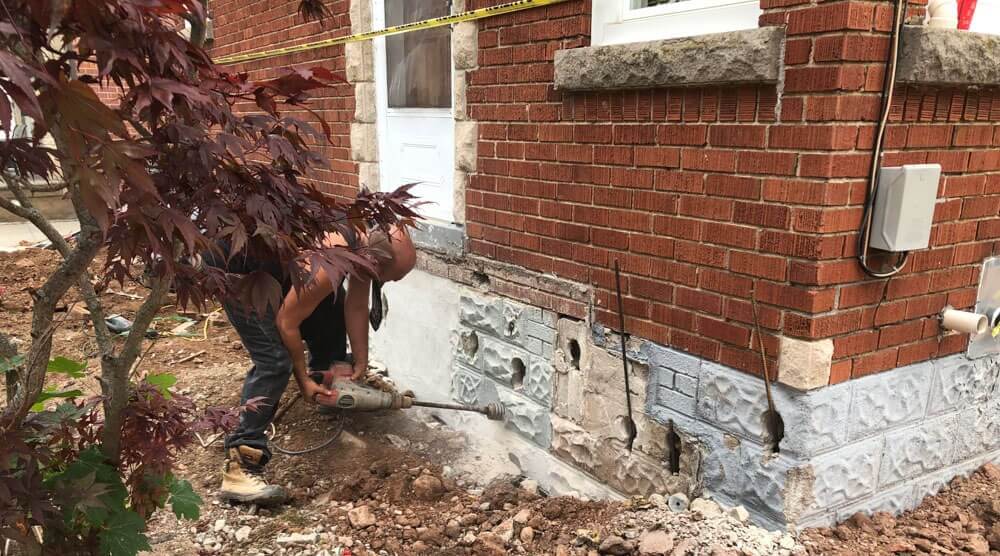
The Process: Pumping Concrete and Rebar into Hollow Blocks
Top Cell Access & Core Clearance: Technicians cut access openings into the top course of the concrete block wall or drill injection ports directly through the interior face of individual block cells. Any internal debris or mortar droppings within the vertical hollow cores are cleared. Steel Rebar Insertion: Grade 60 continuous steel rebar reinforcement (typically #4, #5, or #6 rebar) is inserted vertically down through the aligned hollow cores from the top bond beam down to the footing course.
Structural Grout / Concrete Pumping: A low-aggregate, high-flow structural grout or self-consolidating concrete with a minimum compressive strength of 2,000 to 3,000 PSI is pumped under pressure into the hollow cores.
Curing and Bond Development: Wet concrete fills the internal hollow block cavities, locks around the horizontal web walls, and cures around the steel rebar. Once fully cured, the structure transfers lateral forces directly onto the internal vertical rebar grid.
What is Carbon Fibre Foundation Stabilization?
Carbon fibre structural stabilization adapts high-tensile composite technology for residential foundation repair. Carbon fibre reinforced polymers (CFRP) utilize ultra-high-tensile carbon yarns encapsulated within an epoxy resin matrix, creating flexible straps with tensile strengths up to ten times greater than structural steel.
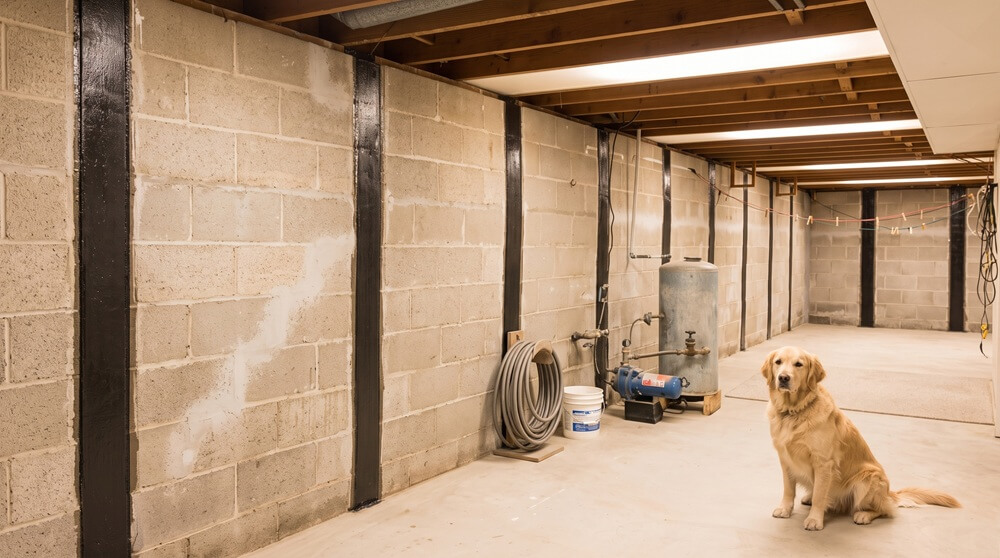
Carbon fibre straps possess zero compressive capacity but extraordinary ultimate tensile strength (frequently exceeding 150,000 to 350,000 PSI, compared to 60,000 PSI for Grade 60 rebar). When bonded to the interior wall face using high-shear structural epoxy, any lateral force trying to push the wall inward engages the carbon fibers in pure tension. Because carbon fibre does not stretch or creep under load, wall deflection is locked in place permanently.
Surface Preparation: The interior face of the hollow concrete block wall is ground clean using diamond grinding equipment to expose raw, sound masonry.
Structural Crack Repair: Prominent horizontal cracking and mortared joints are injected with structural polyurethane or high-viscosity epoxy to lock the masonry units together. Epoxy Saturation & Strap Application: A specialized two-part structural epoxy matrix is applied directly to the prepped block surface, and woven carbon fibre straps are embedded and saturated thoroughly.
Top & Bottom Anchorage: Top rim-joist brackets and bottom sill/footing anchors are mechanically fastened to lock the carbon fibre strap into the building frame.
Structural Comparison: When to Core-Fill vs. When to Strap
Choosing between core-fill rebar reinforcement and carbon fibre composite stabilization requires evaluating structural load and total wall deflection. Neither system is a universal fix for every degree of foundation distress.
Primary Load Resistance: Concrete block core-filling relies on internal mass, flexural strength, and shear resistance. Carbon fibre strapping relies on extreme interior face tensile resistance.
Deflection Thresholds: Carbon fibre is ideal for minor to moderate bowing (less than 2 inches / 50 mm). Core-filling is designed for moderate to severe bowing (greater than 2 inches / 50 mm).
Tensile Strength: Standard Grade 60 steel rebar rates at ~60,000 PSI, whereas carbon fibre CFRP straps rate between 150,000 to 350,000+ PSI.
Spatial and Labour Footprint: Both systems preserve interior floor area. However, carbon fibre installation involves light hand tools and diamond grinding, whereas core-filling requires concrete pumps, heavy equipment, and extensive core cleanouts.
Ability to Straighten Walls: Carbon fibre stabilizes the wall in place and prevents further movement, but does not pull it back. Core-filling can be combined with exterior excavation and mechanical jacking to straighten the wall before pouring.
An often-overlooked detail is internal block drainage. Many bowing basement walls feature internal perimeter weeping systems that rely on hollow block cores to funnel water down to a sump basin. Core-filling completely blocks these vertical channels with solid concrete, potentially forcing trapped groundwater through unsealed mortar joints unless exterior waterproofing is upgraded concurrently.
Cost Analysis and Longevity for Southern Ontario Clay Soils
Regional soil geology plays a monumental role in foundation performance, particularly in Southern Ontario, the Greater Toronto Area (GTA), Hamilton, and the Niagara Peninsula. This region is dominated by highly expansive clay soils. Expansive clay acts like a sponge: absorbing vast quantities of water during wet spring months and swelling, then shrinking during dry summer months to create fissures that rapidly flash-fill with water during heavy rain. This generates extreme spikes in hydrostatic pressure and frost heave forces.
For Carbon Fibre CFRP Strapping, costs typically range from $600 to $1,000 CAD per vertical strap (installed every 3 to 4 feet along the wall), resulting in an average total project cost of $4,000 to $8,500 CAD. Installation takes 1 to 2 days with virtually no mess, and the material is non-corrosive, impervious to chemical degradation, and offers lifetime transferable warranties. For Concrete Block Core-Filling, costs typically range from $120 to $250+ CAD per linear foot, resulting in an average total project cost of $1,000 to $2,000+ CAD when factoring in wall access, rebar doweling, high-pressure concrete pumping, and cleanup. Installation takes 3 to 5 days of heavy labour, and while strong, embedded steel rebar remains susceptible to internal corrosion over multi-decade lifespans if water penetrates the masonry shell.
In Southern Ontario regions that have pockets of clay soil, like Waterdown, Flamborough, Inland Halton and parts of Ancaster, carbon fibre composite systems offer an exceptional cost-to-performance ratio for walls bowing less than 2 inches. Because carbon fibre does not corrode when exposed to moisture or alkali in concrete, it eliminates the risk of internal rust expansion that can affect steel rebar reinforcement over time. However, if a shifting foundation exhibits both severe horizontal bowing and horizontal sliding at the base (footing shear), core-filling paired with steel dowels or complete wall replacement becomes necessary.
Contact Conterra Foundation Today
Both concrete block core-filling and carbon fibre wall strapping are proven engineering methodologies for arresting inward wall deflection. For minor to moderate deflection (under 2 inches) caused by hydrostatic pressure, carbon fibre structural stabilization provides a cleaner, cost-effective, non-corrosive, and minimally invasive system that locks the wall permanently in place. For severe structural failure, massive wall rotation, or extreme shear displacement, core-filling with concrete and vertical rebar remains the heavy-duty structural remedy required to rebuild foundation capacity.
Property owners suspecting a shifting foundation or observing horizontal cracking should consult a licensed structural engineer or foundation specialist to evaluate conditions and select the optimal stabilization system. Contact Conterra Foundation to ensure your walls are being reinforced properly and reliably.